How to Plan Mould Quantity for a CLC Block Line
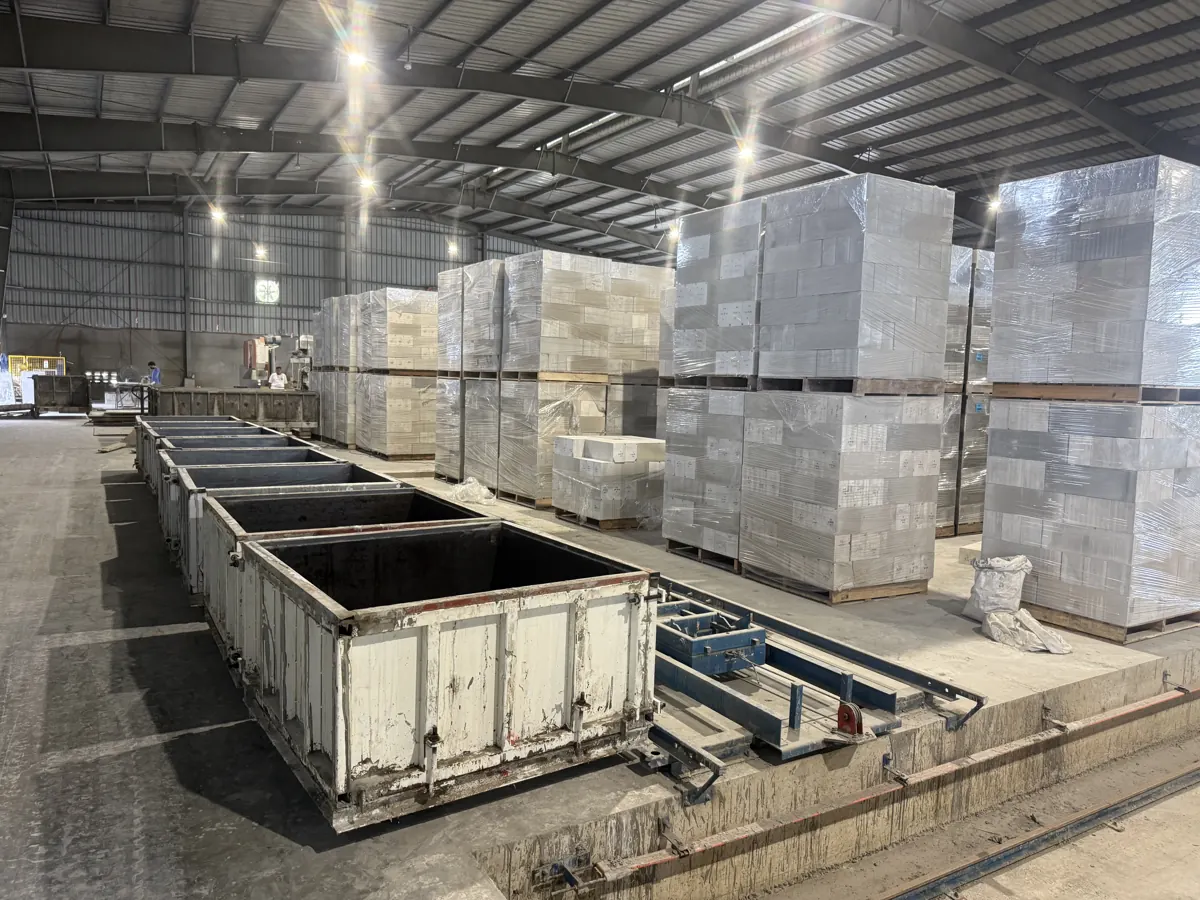
Mould quantity is a circulation calculation: how many components remain occupied while the next batch is ready to cast? HENGDE plans frames, bases, curing positions and return movements together. The result is a working fleet for the selected schedule—not a quantity guessed from the mixer size or the photograph of one mould.
Start with usable volume and the casting schedule
Required fillings = planned casting volume ÷ usable cast volume per mould, rounded up to a complete filling. Use the measured or engineered fill volume, including the chosen fill level. Overall dimensions and nominal mould dimensions do not automatically establish usable volume.
Illustrative example, not a HENGDE package specification: casting 40 m³ into moulds with 2 m³ usable volume needs 20 fillings. That does not always mean 20 complete mould sets. A component can support another filling after it returns; alternatively, a body can keep its base occupied beyond the casting shift.
The schedule must show when casting starts and stops, how fills are spaced, and whether bodies remain overnight. Average daily volume alone hides the hours when several components are needed simultaneously.
How do we size moulds for a 100 m³/day CLC line?
For a 100 m³/day CLC block line, HENGDE starts with the selected configuration and the agreed casting schedule. We calculate frame and base occupation separately, carry unfinished cycles into the next shift and check the peak simultaneous requirement. The headline capacity alone does not specify the mould fleet.
Read the 100 m³/day equipment-list guide alongside that schedule. A reference mould entry identifies an equipment item; it is not the complete turnover quantity. The project layout must also provide curing positions, return access and space for bodies waiting for cutting.
Calculate the frame and the base separately
A frame can release while the body remains on its base for further curing, cutting and transfer. The frame then needs cleaning, assembly and return. The base becomes available only after the body leaves it and the base is prepared for the next filling. These are different occupation periods.
| Component | Start of occupation | End of occupation | Include in its cycle |
|---|---|---|---|
| Frame | Frame committed to the filling position | Cleaned frame ready for another filling | Filling, initial body development, release, cleaning, assembly and return. |
| Base/pallet | Base committed to a body | Prepared base ready for another filling | Filling, body support, waiting, cutting/transfer, cleaning and return. |
| Curing position | Filled mould/body enters the location | Location clear for the next body | The actual release route, access and transfer timing. |
Use the actual equipment arrangement to establish these endpoints. HENGDE’s mould-return plan connects demoulding, cutting and product handling; extra frames do not free bases that are still waiting behind a blocked cutter.
Use the rate calculation, then verify peak occupation
For a uniform sustained filling schedule: working components ≈ filling rate × component occupation time, rounded up. This is a useful first calculation. A timeline provides the final peak requirement for an interrupted or multi-shift schedule.
Illustrative calculation: assume two fillings per hour, with a six-hour frame cycle and a fourteen-hour base cycle, sustained long enough to reach those occupations. The working requirement is 2 × 6 = 12 frames and 2 × 14 = 28 bases. The assumed cycle times are not recommended release times; they demonstrate why buying equal numbers without studying the process can leave casting short of bases.
Now put each fill on a timeline. At each planned filling time, count components from earlier fills that have not returned. Add the components needed for that fill.
The largest simultaneous count is the working minimum for that schedule. Carry occupied components across midnight instead of resetting the count at the next shift.
Routine cleaning and return already belong in the occupation time. Add an identified reserve for components taken out of circulation for repairs or other planned unavailability; do not double-count normal cleaning as both cycle time and reserve. If a shift ends with twelve bases still occupied, the next crew inherits those twelve, even when its report starts a new date.
How does the 200 m³ standard proposal use moulds?
HENGDE’s square-mould standard proposal lists 100 mould sets, with a frame, baseboard and base wheels, and a nominal specification of 1,200 × 1,200 × 600 mm. Its production basis is designed cutting volume over two shifts totalling 16 hours. The proposal also describes frame release, subsequent body curing, cutting and transfer off the base.
Those 100 sets are the documented proposal requirement, not proof of 200 m³ of qualified finished product. The production trial establishes the actual release conditions, completed cycles and accepted product. Do not replace that requirement with the “one reference mould set” entry on another equipment list, or transfer an eight-hour capacity assumption into this sixteen-hour proposal.
The complete factory guide explains this specific standard proposal. The 200 m³ capacity reference page retains its own configuration and planning basis. HENGDE identifies the chosen version in the equipment schedule and layout.
Read the shortage before buying more moulds
| Observed shortage | What to measure | Engineering response |
|---|---|---|
| Empty frames unavailable | Release, cleaning, assembly and return times | Remove frame-cycle delays and calculate the remaining quantity gap. |
| Frames available but bases unavailable | Body waiting, cutting, palletizing and base return | Correct the base-holding stage before adding more frames. |
| Filled moulds block circulation | Curing-position occupation, access and transfer sequence | Improve layout and release movement; added moulds alone add congestion. |
| Ready bodies queue at the cutter | Full loading/cutting/unloading cycle and downstream space | Balance cutting and handling with the casting schedule. |
See the Philippines line-upgrade project for real factory and equipment references. Our capacity and layout planning service connects the CLC line, mould fleet and usable factory space.
Get a Mould Circulation Plan for Your Factory
Send your mould drawings, fill volume, casting schedule and observed frame/base return times. HENGDE will develop the working quantity and circulation layout for the selected line.